Lalitpur, Nepal
Welcome to Gan Research and Learning Center
Welcome to Gan Research and Learning Center
Lalitpur, Nepal
Dignity without Danger (DWD) action Research collaborative project has been carried out by Liverpool John Moore University and SOAS UK in collaboration with Department of Sociology, Tribhuvan University and six NGO partners in Nepal led by Global Action Nepal. The Research was carried out in 13 districts in 7 provinces in Nepal.
The study explores the origin, diversity and impact of social, cultural and religious menstrual practices in Nepal which deny women and girls the right to a healthy and dignified menstruation. It focuses on promoting women's right to sexual and reproductive health. Nepal being one of the underdeveloped countries in Asia, the situation of every girls and women calls for this attention for their own right and dignity. The diverse cultural belief and social barriers of traditional customs on ill-menstrual practices is hard to break in different parts of Nepal. DWD aims to put in collaborative effort to create a platform to support girls and women for their rights and create strategies for their voice to be heard to face and overcome such challenges. A workshop organized in 2019 by DWD concluded that educating children on menstruation process from the early age and community dialogues with parents are the key to end the menstruation issues in the country
the recent revision in school curriculum to include MHM as a topic from grade 4 to 12 demands
supplementary
resource materials for children and teachers to make students learning on menstruation
inside the classroom
with ease. In this scenario GIZ, John Moore University and Global Action Nepal came with the
idea of collating all
materials and finding the materials gap, developing as per the new curriculum and piloting
these existing and new
products in different geographical region of the country It has been observed that a rich
array of education
materials prepared by different organizations, Government agencies Ministry of Education,
Ministry of Health
and Family planning.
Therefore, the need has been identified to compile and make an index of existing
teaching and learning materials
around the topic of menstruation in order to provide teachers and health educators a
comprehensive choice
according to different age group.
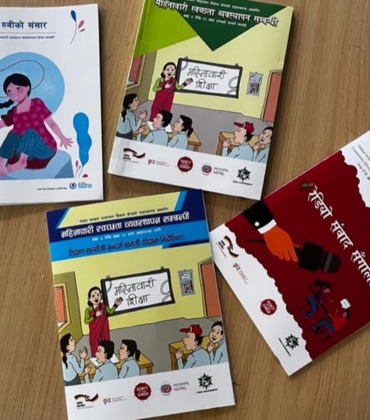
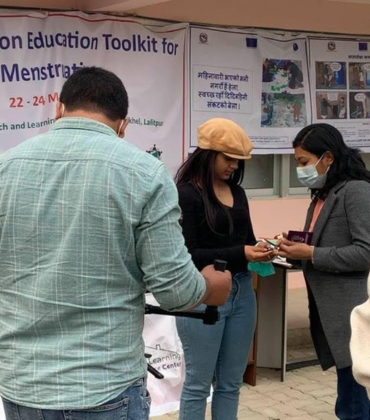
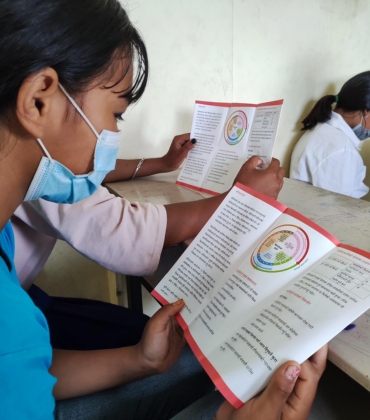
The education toolkit thus serves as a support for teachers and students to teach and learn
about menstruation in
and inter disciplinary way. It will include education materials developed by members of
MHMPA during the past
years.
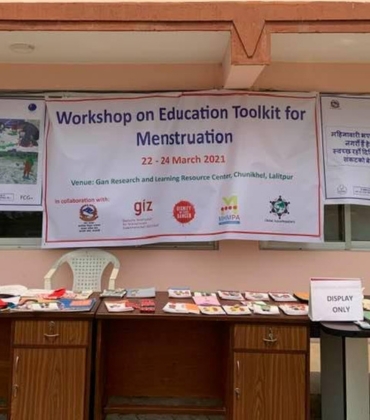
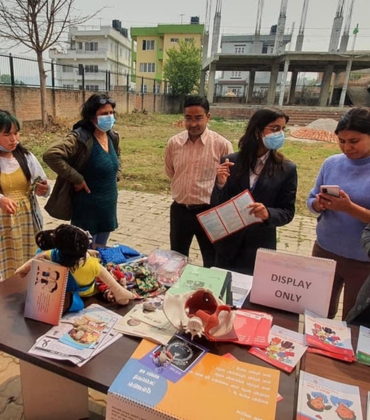
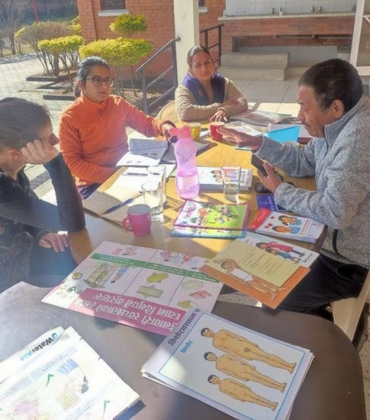
A three day long residential workshop was organized at the Gan Learning and Resource Centre in March 2021 for the assessment of existing available materials and gap identification against the new curriculum from 4-12 grades. A total of 29 participants were present from different organizations including MHMPA members, DWD partners, technical persons working on MHM, government officials. During the workshop, the representatives of the organizations presented their products and get engaged in discussing who it is for and how they will be used in schools or in the community. The discussions were narrowed down to specifying materials for particular level of the new curriculum developed by the CDC. As a result, gaps were identified between existing MHM materials and requirements in the new curriculum
Following the workshop assessment of materials and gap identification, a day long interaction
program on MHM
disable and third gender friendly materials and n new curriculum was carried out on 25 th May
2021. The
interaction program was found to be beneficial however, there were no existing MHM related
disable and third
gender friendly materials are available in the market . It has identified their issues and came
with suggestions as
given below :21 participants were presented in the interaction program.
1. Materials should consider gender friendly
2. Materials should focus on counseling and psychological support for people related with
disability
3.Need to include that menstruation also happens to transgender male as well
4. The education kit should also consider third gender, transgender, types of disability in
the content and
examples and if possible with pictures
5.Need to advocate for universal designed toilet for uniformity and easy to use for people
with disability.
As per the outcome of materials gap identification, a 3 days long residential workshop was
organized for the
development of materials as required by the curriculum on 10-12 April 2021 at Gan Research and
Learning
Resource Center, Lalitpur. During the workshop participants were divided into 3 groups as group
one was assigned
for Grade 4,5, and 6, group 2 was assigned for Grade 7,8, and 9 and group 3 was assigned for
Grade 10,11 and 12.
All the groups rigorously worked on their assigned task and prepared materials for the tool kit
. During the
workshop, participants also revisited the outcomes of previous workshop and assessment of
existing materials.
A total of 23 participants representing members of MHMPA and partners of DWD were present
in the workshop.
The materials were produced from 3 different groups.